
How Nancy Yu learned to make armour from the inside out
Nancy Yu (NC Qin) works in cast glass and flamework, building objects that are simultaneously ancient and contemporary—headdresses, armour, helmets, crowns—and asking what happens when the things we wear to protect ourselves become the very things that hurt us.
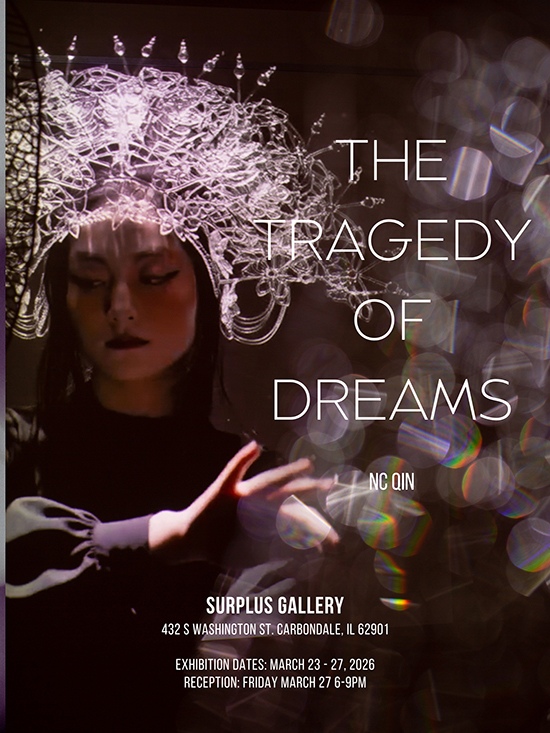
She recently completed her MFA at Southern Illinois University Carbondale under master glass artist Jiyong Lee, and is preparing to return to Sydney to establish her own studio. I spoke with her the week of her thesis exhibition, The Tragedy of Dreams.
The Conversation
Part I: Formation
I think I had an affinity for glass before I even knew it was an art form. In high school, for my graduation sculpture, I imagined a glass woman emerging from water, a kind of rebirth scene. My teacher hadn't even heard that you could cast glass, but I'd learned about the lost-wax process and assumed it would work the same way. I was half right. The idea I had was completely beyond my technical abilities at the time. Even now, with all the experience I have, it would still be a challenge.
Cast glass lends itself to sculptural form in a way blown glass doesn't—it's not entirely transparent because of the textures it picks up from the mould, and that adds gravitas. But beyond the visual, cast glass has shaped me as a person as much as an artist. It has a very high failure rate. At the beginning I was failing almost 70% of the time. It drilled into me caution, systems, and persistence.
When you work with cast glass, you have to know what you want to make from the very beginning. It's very hard to change your mind midway through once you've already made a master mould. For me, envisioning what I want to make is probably the most exciting part of the process. The rest is problem solving—understanding your materials, making the journey toward the vision. I generally get pretty close to where I started.
Part II: The Work
It started on the floor of my room.
I was in my last year of my bachelor's, going through my first real heartbreak and quite a bit of depression alongside it. The anxiety of entering the real world as an artist—no security, no clear path. And even though I was back in Australia, surrounded by friends and family, I found myself hesitant to reach out to any of them. I kept everything building up inside until I was crushed by the weight of it. One day I just fell to my knees, breaking down.
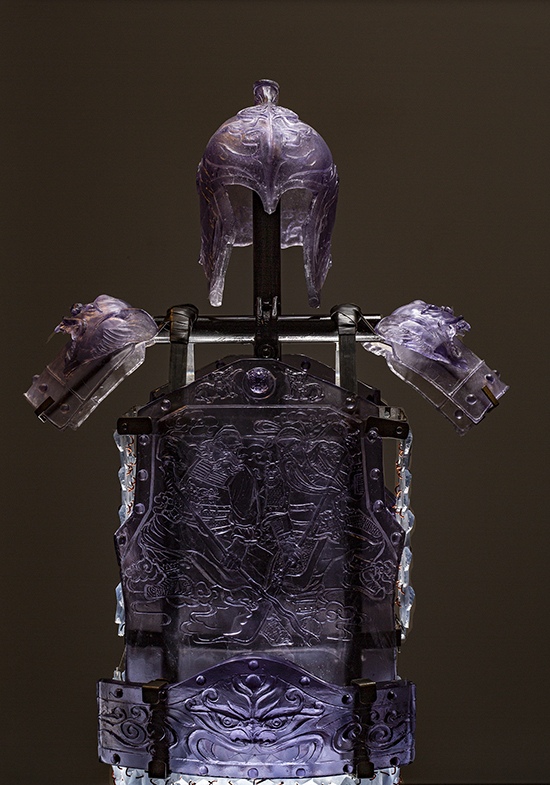
When I journaled about it afterward, I described what I'd been carrying as a pseudo glass armour. I thought my pride was protecting me, but it was actually isolating me from everyone else. And the key was the material—if it shatters, it hurts the wearer rather than protecting them. The armour itself becomes dysfunctional. That's the central image of the whole series.
Always there, just not yet consciously activated. My dad's favourite character is Guangyu from the Three Kingdoms—the 14th-century historical novel and foundational text of East Asian literature that chronicles the power struggles of competing dynasties. He is the archetypal hero that older Asian men aspire to, a figure of loyalty, a brother. As bedtime stories, my dad told me about these ancient heroes. My mom was absorbed in the dramas of the Qing dynasty. This was the air of my childhood.
But being from an intersection culture—Chinese at home, Australian in the world—I read these stories differently than my father did. When he looks at Guangyu, he sees the most loyal of soldiers. When I read Guangyu's story, I saw his fatal flaw: a man who placed his pride and arrogance above all else. That's why he's in the armour. I was thinking of pride not as the opposite of shame, but as its source.
The exhibition is structured around two large handwritten letters, vinyled directly onto the gallery walls—one addressed to my eight-year-old self, one to my eighty-year-old self. I chose these ages deliberately. Eight is that threshold of fearless projection, where imagination is still unconstrained by lived reality. Eighty gestures toward retrospection, toward a relationship with memory that may be beginning to falter. Between them lies the entirety of a life shaped by the act of dreaming.
I came across a quote that said: “There are only two people you should aim to make proud in your life. Eight-year-old you and eighty-year-old you.” It articulates something that institutional language usually can't.
The first body of work, Artists' Hands, sits beneath the letter to my eight-year-old self. It's the most intimate—a lineup of translucent glass hands cast from the dominant hands of artists. In performance, I use a gavel to shatter them. The artist's hand is not just a physical tool. It's the primary means by which creative vision is brought to life, but also shaped by that very labour—marked by calluses, worn by repetition. The shattering is a metaphor for the toll that making takes on the body.
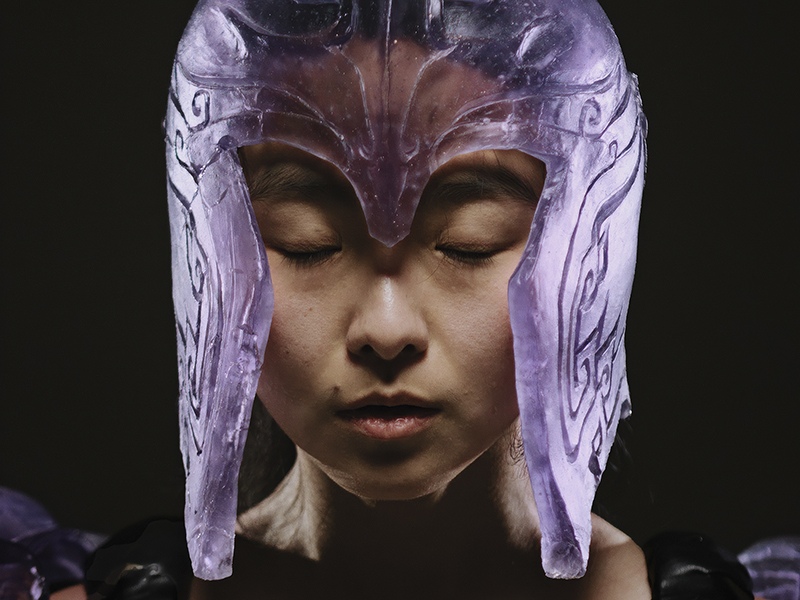
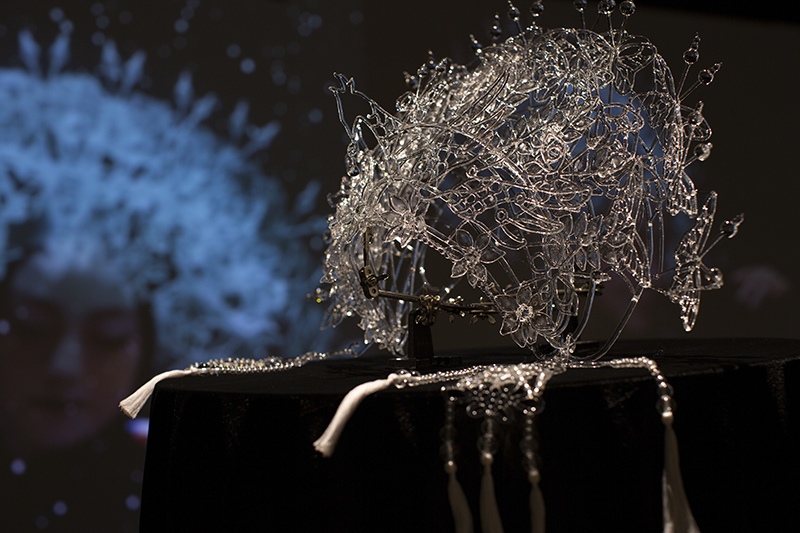
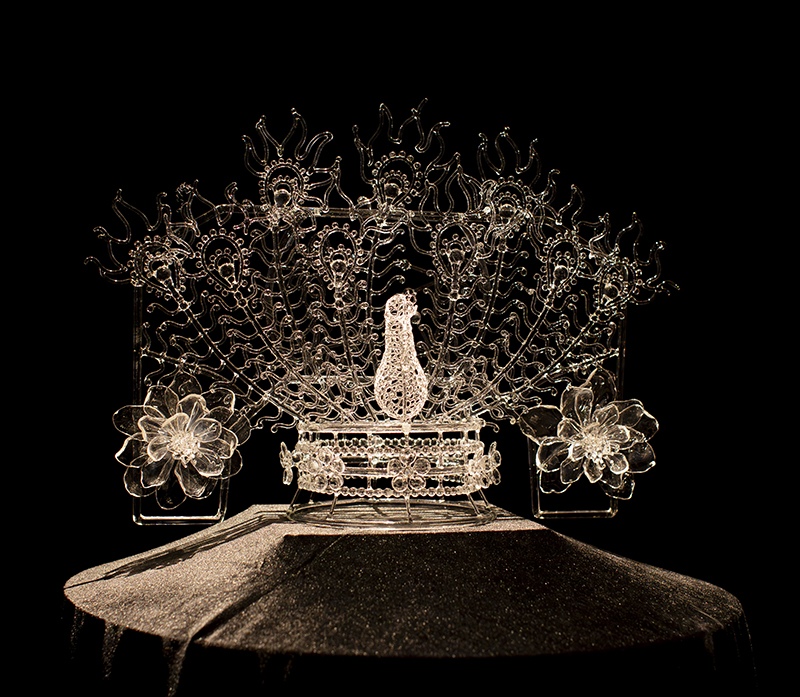
Crowns of Glass shifts from the act of making to the moment of arrival. It's a trio of flameworked headgear—two headdresses and a helmet. Behind them, a dual-screen projection plays Ideal vs. Truth, a work that sets an AI-generated figure wearing the headdresses alongside a live performance of me doing the same. The AI figure moves with complete confidence; the live performance reveals the reality: my body tentative, constrained, governed by the persistent fear that the headdress will slip and shatter.
The headdresses draw from historical figures. Yang Guifei is celebrated as one of the Four Beauties of ancient China. At the end of her life, she was executed, and the poet Bai Juyi lamented that her headdress fell to the ground and no one picked it up. An object once laden with power, abandoned. The glass makes that precariousness visible.
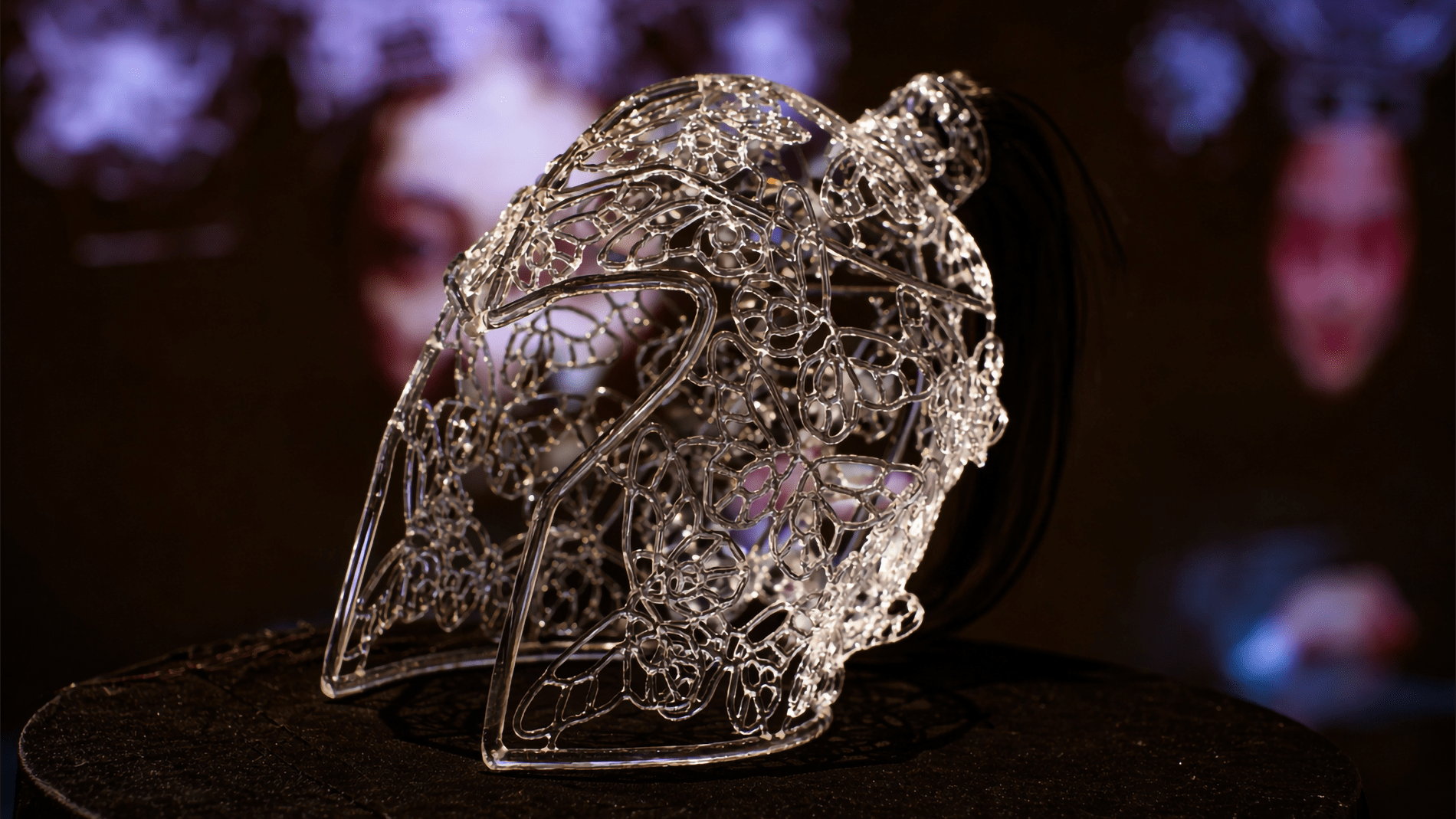
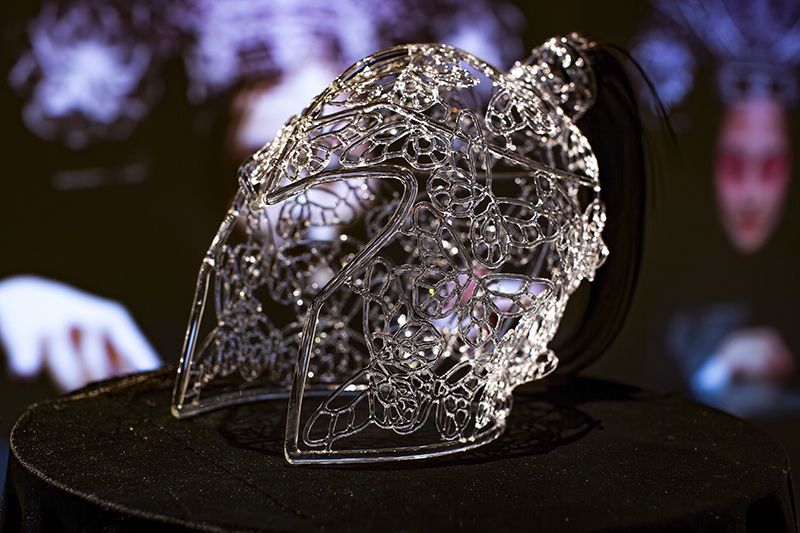
The third piece, the Butterfly Helmet, is a Han dynasty-inspired glass helmet adorned with monarch butterfly outlines. Monarch butterflies are defined by migration—journeys that span vast distances across generations. That felt accurate to my experience of coming to America.
The final work, Icarus II, spans the entire back wall—a life-sized body cast in paraffin wax from my own, with glass wings spread to a three-metre span. Inside the wax body is a constructed nervous system of copper wiring connected to heat coils. The body doesn't fall. It melts, slowly, from the inside out. In the original myth, Icarus falls because the wax of his wings melts as he flies too close to the sun. In Icarus II, the wings, now made of glass and technical precision, don't fail. The body gives way instead. The source of destruction is internal.
Very consciously. The obvious associations are there—fragile, vulnerable, precious. But there's an added layer: when glass breaks, it forms a conchoidal fracture so sharp it can reach molecular thinness. So when you pair glass with the body, you're not just afraid of a beautiful object breaking. You're afraid of what happens to the person wearing it when it does.
Part III: Identity and Displacement
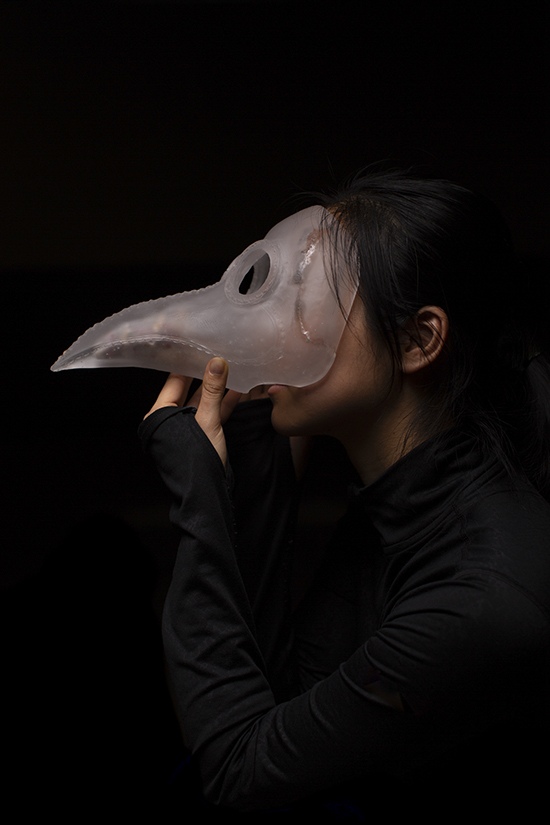
I think I used it subconsciously quite early, but it became conscious during COVID. Not belonging completely to either world means you can see the gap between them. That became the Birdsong series—17th century European plague doctor masks rebuilt with traditional Chinese medicinal herbs inside. Merging the symbols of both traditions into one object.
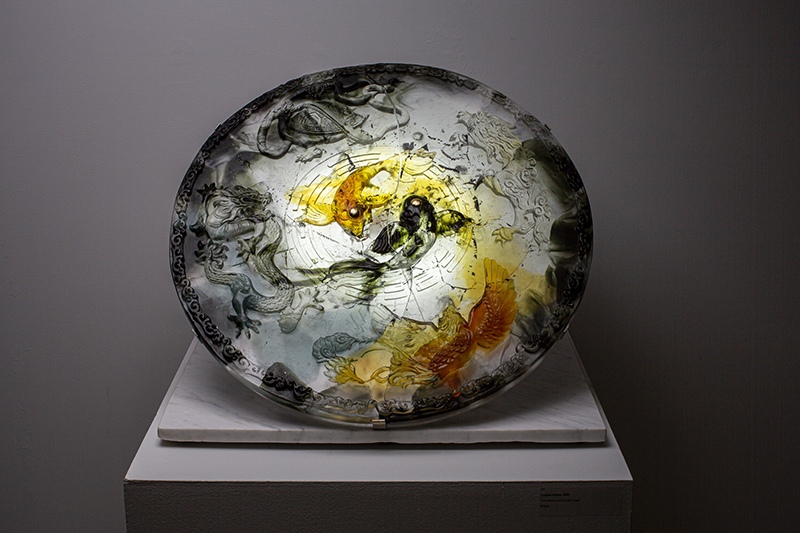
In China, the phoenix Zhu Que guards the South because the phoenix represents fire and heat, which correlates to Chinese geography where the equator is to the south. That doesn't work in Australia. It reminded me of the Chinese saying: when citrus grows south of the Huai River, it is a mandarin; when it grows north, it becomes a trifoliate orange. The same seed, a different environment, qualitative changes in what it becomes.
Yes. Dreams, in Bloch's sense, aren't passive—they're active, structuring how we perceive meaning. But they're also unstable. A tragedy, in the classical sense, isn't defined solely by sorrow. It emerges when a figure recognises that a devastating future may lie ahead and moves toward it anyway. That tension between knowledge and will is what gives tragedy its weight.
Coda
Nancy Yu has returned to Sydney, where she is establishing her own studio. Her work is held in the National Art Glass Collection at Wagga Wagga Art Gallery and she is represented in New Glass Review 44 at the Corning Museum of Glass. .
Her teacher at SIU, Jiyong Lee, described his role as the scaffolding from which students build their foundations—meant to fall away once the building is complete. She told me this, and then added quietly: “It's a very poetic way of describing what a teacher does.”
Glass, after all, is what remains after the scaffolding falls.
How Nancy Yu learned to make armour from the inside out
Nancy Yu (NC Qin) works in cast glass and flamework, building objects that are simultaneously ancient and contemporary—headdresses, armour, helmets, crowns—and asking what happens when the things we wear to protect ourselves become the very things that hurt us.
She recently completed her MFA at Southern Illinois University Carbondale under master glass artist Jiyong Lee, and is preparing to return to Sydney to establish her own studio. I spoke with her the week of her thesis exhibition, The Tragedy of Dreams.
The Conversation
Part I: Formation
I think I had an affinity for glass before I even knew it was an art form. In high school, for my graduation sculpture, I imagined a glass woman emerging from water, a kind of rebirth scene. My teacher hadn't even heard that you could cast glass, but I'd learned about the lost-wax process and assumed it would work the same way. I was half right. The idea I had was completely beyond my technical abilities at the time. Even now, with all the experience I have, it would still be a challenge.
Cast glass lends itself to sculptural form in a way blown glass doesn't—it's not entirely transparent because of the textures it picks up from the mould, and that adds gravitas. But beyond the visual, cast glass has shaped me as a person as much as an artist. It has a very high failure rate. At the beginning I was failing almost 70% of the time. It drilled into me caution, systems, and persistence.
When you work with cast glass, you have to know what you want to make from the very beginning. It's very hard to change your mind midway through once you've already made a master mould. For me, envisioning what I want to make is probably the most exciting part of the process. The rest is problem solving—understanding your materials, making the journey toward the vision. I generally get pretty close to where I started.
Part II: The Work
It started on the floor of my room.
I was in my last year of my bachelor's, going through my first real heartbreak and quite a bit of depression alongside it. The anxiety of entering the real world as an artist—no security, no clear path. And even though I was back in Australia, surrounded by friends and family, I found myself hesitant to reach out to any of them. I kept everything building up inside until I was crushed by the weight of it. One day I just fell to my knees, breaking down.
When I journaled about it afterward, I described what I'd been carrying as a pseudo glass armour. I thought my pride was protecting me, but it was actually isolating me from everyone else. And the key was the material—if it shatters, it hurts the wearer rather than protecting them. The armour itself becomes dysfunctional. That's the central image of the whole series.
Always there, just not yet consciously activated. My dad's favourite character is Guangyu from the Three Kingdoms—the 14th-century historical novel and foundational text of East Asian literature that chronicles the power struggles of competing dynasties. He is the archetypal hero that older Asian men aspire to, a figure of loyalty, a brother. As bedtime stories, my dad told me about these ancient heroes. My mom was absorbed in the dramas of the Qing dynasty. This was the air of my childhood.
But being from an intersection culture—Chinese at home, Australian in the world—I read these stories differently than my father did. When he looks at Guangyu, he sees the most loyal of soldiers. When I read Guangyu's story, I saw his fatal flaw: a man who placed his pride and arrogance above all else. That's why he's in the armour. I was thinking of pride not as the opposite of shame, but as its source.
The exhibition is structured around two large handwritten letters, vinyled directly onto the gallery walls—one addressed to my eight-year-old self, one to my eighty-year-old self. I chose these ages deliberately. Eight is that threshold of fearless projection, where imagination is still unconstrained by lived reality. Eighty gestures toward retrospection, toward a relationship with memory that may be beginning to falter. Between them lies the entirety of a life shaped by the act of dreaming.
I came across a quote that said: “There are only two people you should aim to make proud in your life. Eight-year-old you and eighty-year-old you.” It articulates something that institutional language usually can't.
The first body of work, Artists' Hands, sits beneath the letter to my eight-year-old self. It's the most intimate—a lineup of translucent glass hands cast from the dominant hands of artists. In performance, I use a gavel to shatter them. The artist's hand is not just a physical tool. It's the primary means by which creative vision is brought to life, but also shaped by that very labour—marked by calluses, worn by repetition. The shattering is a metaphor for the toll that making takes on the body.
Crowns of Glass shifts from the act of making to the moment of arrival. It's a trio of flameworked headgear—two headdresses and a helmet. Behind them, a dual-screen projection plays Ideal vs. Truth, a work that sets an AI-generated figure wearing the headdresses alongside a live performance of me doing the same. The AI figure moves with complete confidence; the live performance reveals the reality: my body tentative, constrained, governed by the persistent fear that the headdress will slip and shatter.
The headdresses draw from historical figures. Yang Guifei is celebrated as one of the Four Beauties of ancient China. At the end of her life, she was executed, and the poet Bai Juyi lamented that her headdress fell to the ground and no one picked it up. An object once laden with power, abandoned. The glass makes that precariousness visible.
The third piece, the Butterfly Helmet, is a Han dynasty-inspired glass helmet adorned with monarch butterfly outlines. Monarch butterflies are defined by migration—journeys that span vast distances across generations. That felt accurate to my experience of coming to America.
The final work, Icarus II, spans the entire back wall—a life-sized body cast in paraffin wax from my own, with glass wings spread to a three-metre span. Inside the wax body is a constructed nervous system of copper wiring connected to heat coils. The body doesn't fall. It melts, slowly, from the inside out. In the original myth, Icarus falls because the wax of his wings melts as he flies too close to the sun. In Icarus II, the wings, now made of glass and technical precision, don't fail. The body gives way instead. The source of destruction is internal.
Very consciously. The obvious associations are there—fragile, vulnerable, precious. But there's an added layer: when glass breaks, it forms a conchoidal fracture so sharp it can reach molecular thinness. So when you pair glass with the body, you're not just afraid of a beautiful object breaking. You're afraid of what happens to the person wearing it when it does.
Part III: Identity and Displacement
I think I used it subconsciously quite early, but it became conscious during COVID. Not belonging completely to either world means you can see the gap between them. That became the Birdsong series—17th century European plague doctor masks rebuilt with traditional Chinese medicinal herbs inside. Merging the symbols of both traditions into one object.
In China, the phoenix Zhu Que guards the South because the phoenix represents fire and heat, which correlates to Chinese geography where the equator is to the south. That doesn't work in Australia. It reminded me of the Chinese saying: when citrus grows south of the Huai River, it is a mandarin; when it grows north, it becomes a trifoliate orange. The same seed, a different environment, qualitative changes in what it becomes.
Yes. Dreams, in Bloch's sense, aren't passive—they're active, structuring how we perceive meaning. But they're also unstable. A tragedy, in the classical sense, isn't defined solely by sorrow. It emerges when a figure recognises that a devastating future may lie ahead and moves toward it anyway. That tension between knowledge and will is what gives tragedy its weight.
Coda
Nancy Yu has returned to Sydney, where she is establishing her own studio. Her work is held in the National Art Glass Collection at Wagga Wagga Art Gallery and she is represented in New Glass Review 44 at the Corning Museum of Glass.
Her teacher at SIU, Jiyong Lee, described his role as the scaffolding from which students build their foundations—meant to fall away once the building is complete. She told me this, and then added quietly: “It's a very poetic way of describing what a teacher does.”
Glass, after all, is what remains after the scaffolding falls.