
Kévin Pagès and the Volcanic Landscape That Looked Back
In August 2022, photographer Kévin Pagès hiked twenty-five kilometres through Iceland's volcanic interior with one eye infected and barely open, navigating by the season's first faint aurora toward a crater no map had named.
The dust arrived without warning.
Three days before Kévin Pagès would reach the crater, he and three friends were crossing Mælifellsandur, a vast plain of black volcanic sand in Iceland's central highlands, so stripped of colour it has often been compared to another planet. The storm that caught them there was total. Dust filled the air, the lungs and the eyes. They had no protection for their faces. They stayed anyway, because the conditions were extraordinary, and they were photographers, and this was why they had come.
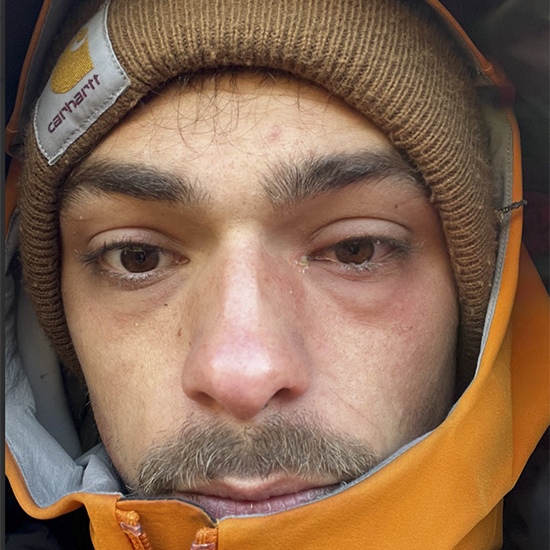
The dust entered his left eye and stayed.
The destination was an unnamed volcanic crater near the headwaters of the river Skaftá, where it begins its descent from Vatnajökull, Europe's largest glacier, a slow white mass covering eight percent of Iceland's surface. Reaching it required driving to the edge of what roads allow, then hiking twenty-five kilometres through terrain that offers no shelter and little marking.
By the time they reached the end of the driveable track, Pagès had been sleeping in fragments. His eye had begun to inflame. A weather forecast shift showed a perfect sunrise the following morning, and he made the decision that would define the journey: they would not sleep and hike at dawn. They would leave at midnight and walk through the dark.
They had one headlamp between four people.
In early August, Iceland does not fully darken. The sky holds a blue residue of light even at its lowest, enough to walk by, not enough to see clearly. Somewhere above them, barely visible against the twilight, the season's first aurora appeared. Not dramatic. Just a faint green stain at the edge of the sky. They noted it and kept walking.
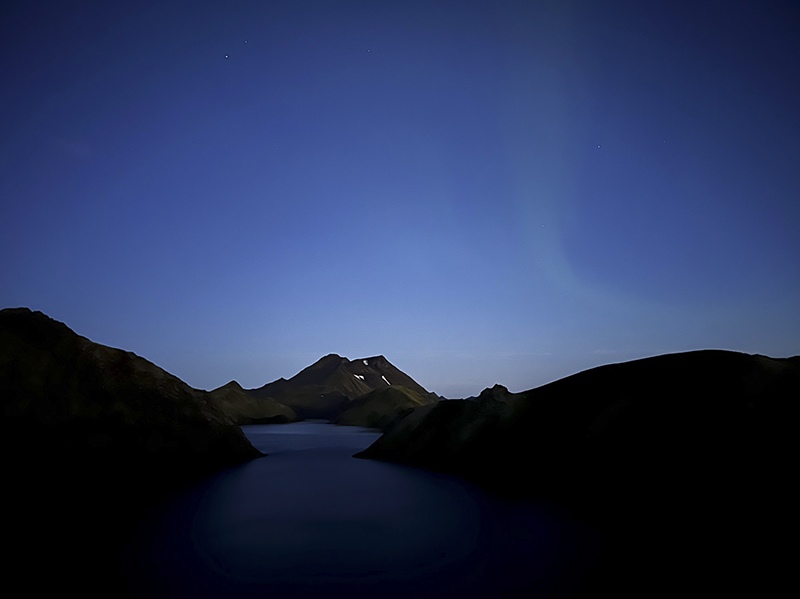
Four hours later, with twenty minutes to spare before sunrise, they reached the crater rim.
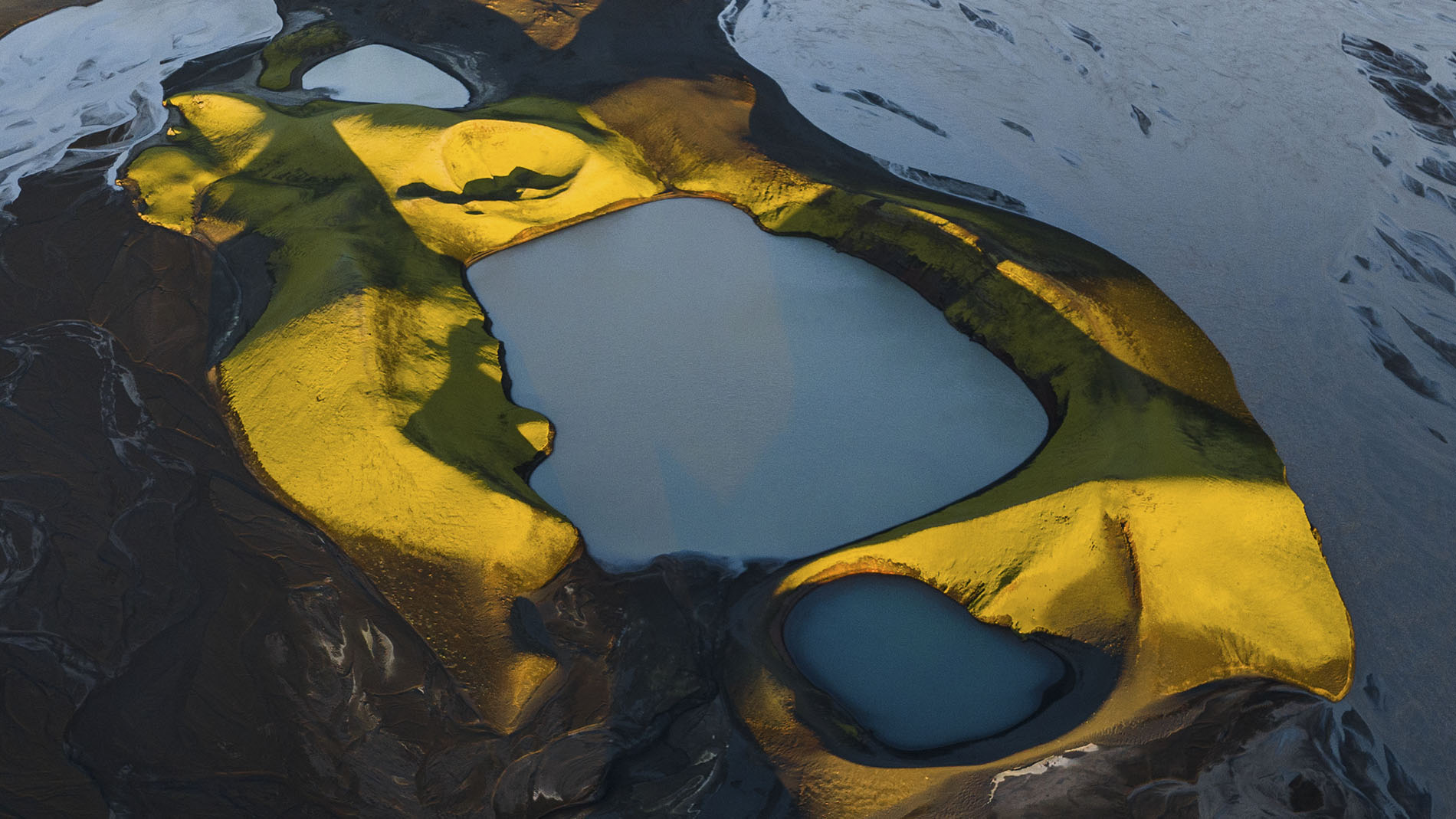
What the drone returned was not what he had expected. The landscape below was organised, or appeared to be, into something that resembled, with unnerving precision, an eye.
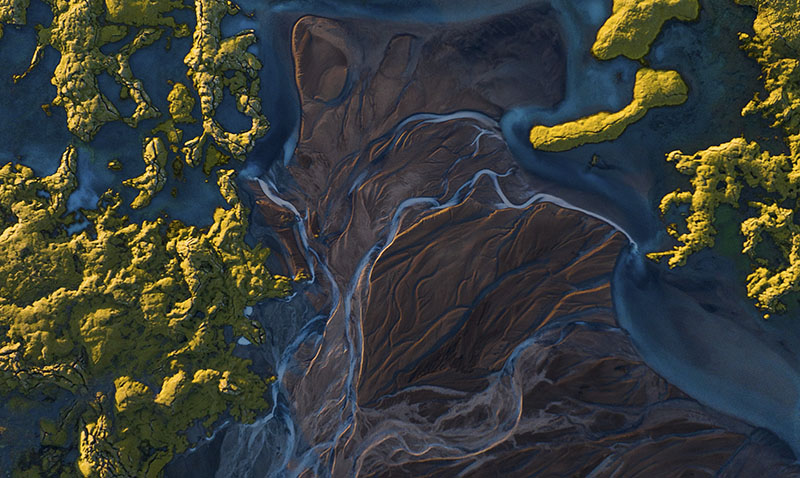
A moss-covered crater island rose from the surrounding glacial sediment, its rim forming a near-perfect oval. At its centre, a lake held still grey light. Below it, a smaller pool sat like a displaced pupil, or a tear. The surrounding plains of black volcanic sand, threaded with white glacial meltwater, spread outward like the fine lines of an iris viewed in extreme close-up. In the low golden light of the Arctic sunrise, the moss had turned a luminous yellow-green, the colour of something alive and watching.
He had hiked through the night with one infected eye, barely able to keep it open. And he had arrived at a crater that looked back.
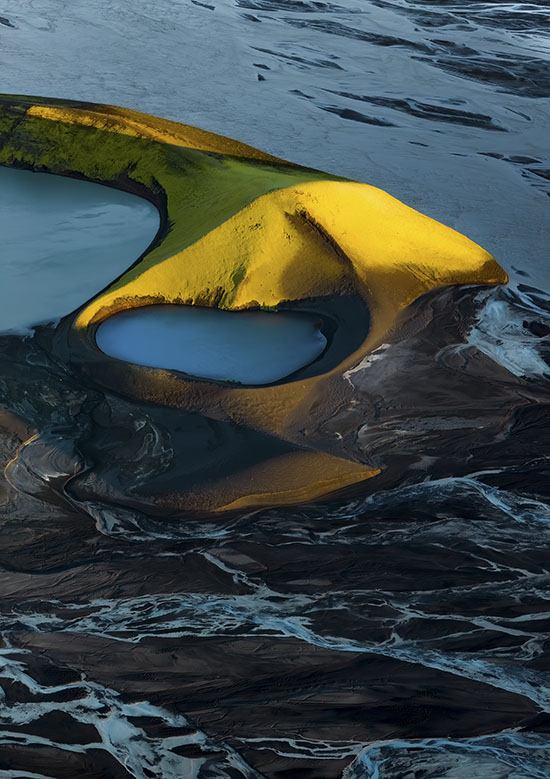
His body had been entered by the landscape before he ever reached it.
The volcanic dust had crossed the boundary of skin and found the most sensitive surface available: the membrane of an eye. By the time the drone lifted above the crater, vision itself had become the subject. He could see with one eye, imperfectly, through pain. What the elevated gaze returned to him was an image of seeing, the crater arranged by geology and glaciation and the chance of a sunrise angle into the form of the very organ the volcano had compromised.
Whether this constitutes encounter or coincidence, the photographs do not answer. They hold it open instead.
A man and a landscape, each having made their mark on the other. The dust in the eye. The eye in the earth.
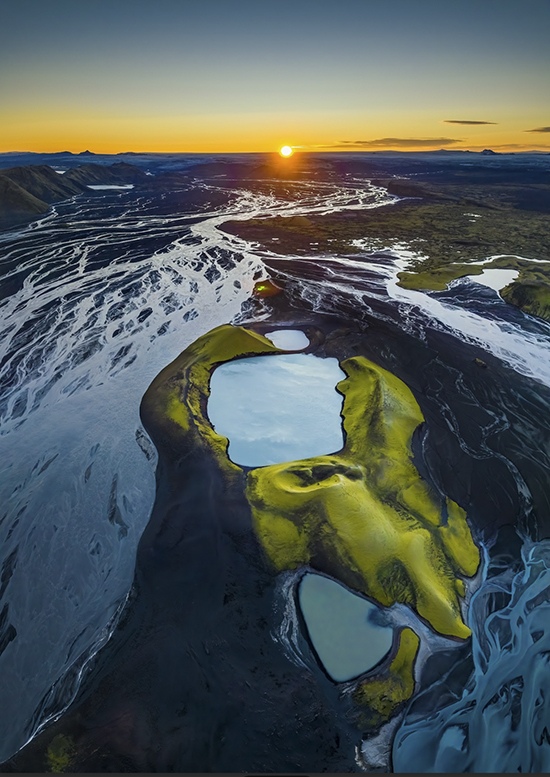
The dust in the eye. The eye in the earth.
The group stayed for two hours. Then they began the twelve-kilometre walk back.
Pagès could barely open his left eye for the return. He drove three hours to the nearest pharmacy after reaching the car, leaving his friends to rest in the highlands while he pushed toward the coast alone.
The following day, a volcanic eruption began on the Reykjanes Peninsula.
They went to see it.
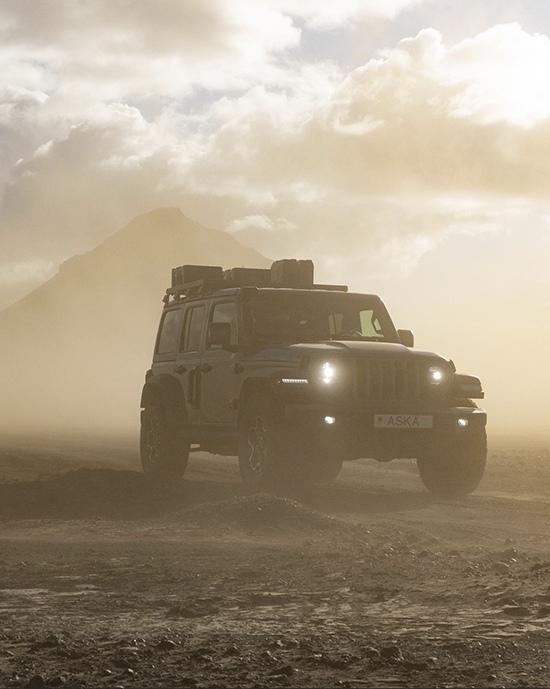
Photographs by Kévin Pagès. Iceland, August 2022.